No two Indian baby showers look the same. The name changes by region, the order of the rituals changes by family, and the person leading it might be a priest, a grandmother or a room full of aunts. What stays constant is why everyone came: to bless the mother-to-be before the baby arrives. Traditions differ from home to home, so treat this guide as a menu, not a script. For every ceremony we cover, see our Indian family ceremonies page.
What Is an Indian Baby Shower Called in Different Regions?
An Indian baby shower is called Godh Bharai in many North Indian families and Seemantham in many South Indian families, with Valaikappu, Sreemantham, Shaad and Dohale Jevan among the other regional names. The name often hints at what happens:
- Godh Bharai, in many North Indian families. The name means filling the lap, and the elders fill her lap or saree fold with fruit, sweets and gifts.
- Seemantham, in many South Indian families. Its Sanskrit name, Simantonnayana, means parting the hair, and it is one of the Hindu samskaras, or rites of passage.
- Valaikappu, in many Tamil families: a bangle ceremony. Some families hold it together with a Seemantham.
- Sreemantham, a name for Seemantham used in many Telugu families.
- Shaad, in many Bengali families, built around feeding the mother-to-be her favorite foods.
- Dohale Jevan, in many Marathi and Konkani families, where the name points to her pregnancy cravings.
Many families blend customs, so the name on the invitation is where the plan starts, not all of it.
Priest-Led or Led by the Women of the Family: What Changes for the Photos?
Who leads the ceremony decides where we stand and how the photos are paced, so it is the first thing we ask. Some versions are priest-led samskaras: a Seemantham traditionally includes a homa, a ritual fire with mantras, and gives the husband his own part in the ritual. Others, including many Valaikappu and Godh Bharai celebrations, are led by the women of the family with no priest at all.
For a priest-led ceremony, we ask the priest beforehand where we may stand, work without flash during the mantras and photograph from the edges. The frames to get are the couple at the fire, the husband's part in the ritual, the priest's hands with the offerings, and the parents watching.
When the women of the family lead, the mother-to-be stays in her chair and the blessings come to her, often with songs. We pick a spot at a slight angle to the chair where we can see her face and the face of whoever is blessing her, and stay there, so every blessing is photographed the same way.
Which Moments Should Indian Baby Shower Photography Capture?
Plan for the bangles, the blessings, the aarti, the flowers, the sweets and the lap-filling, and the couple; your family decides which of these happen and in what order.
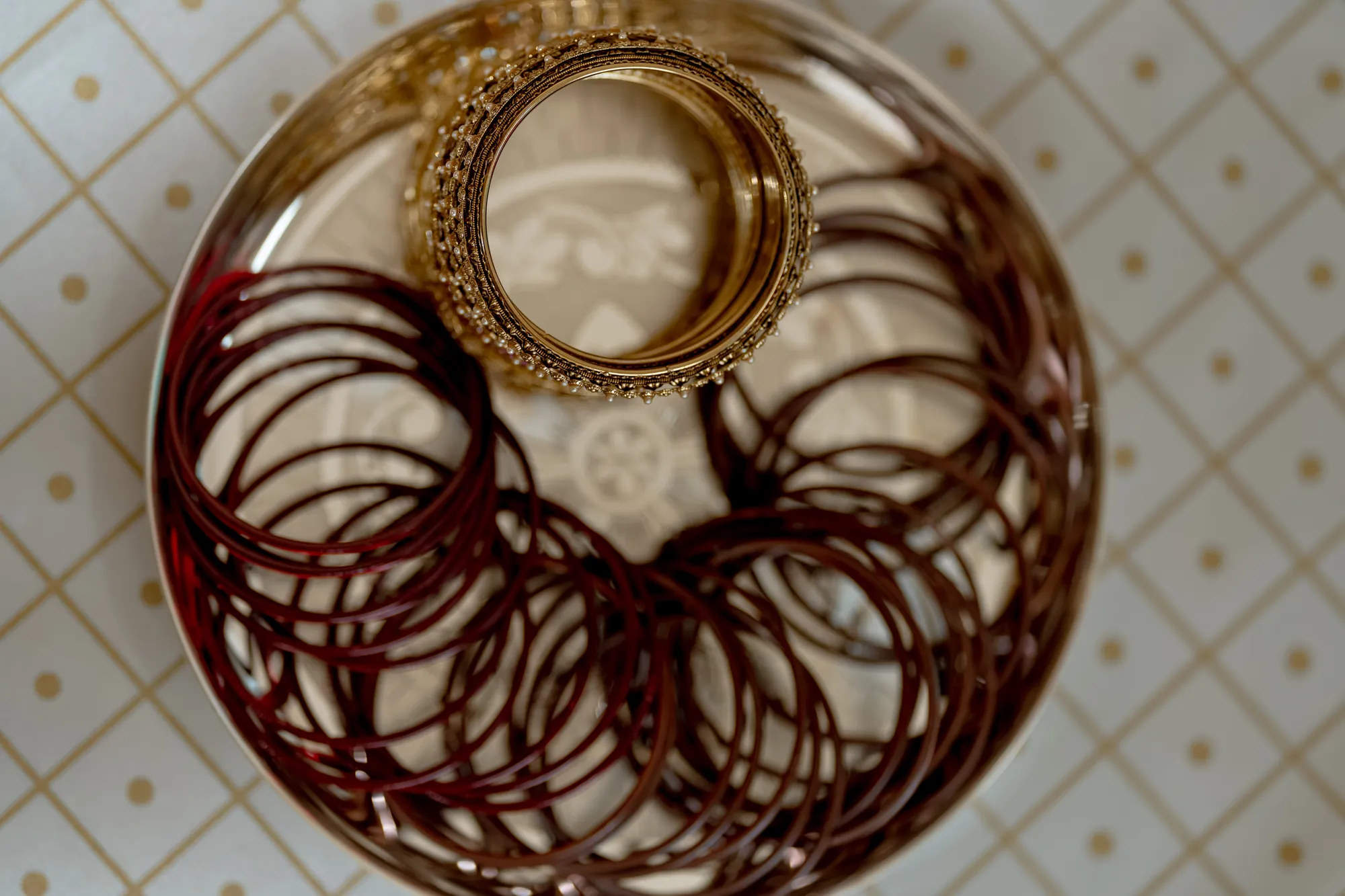
The bangle ceremony. In a Valaikappu the bangles are the heart of the day, and many other versions include them too. In many Tamil families it is said that the sound of the bangles reaches the baby. Photograph the bangles from above before they go on, while the plate is still full.
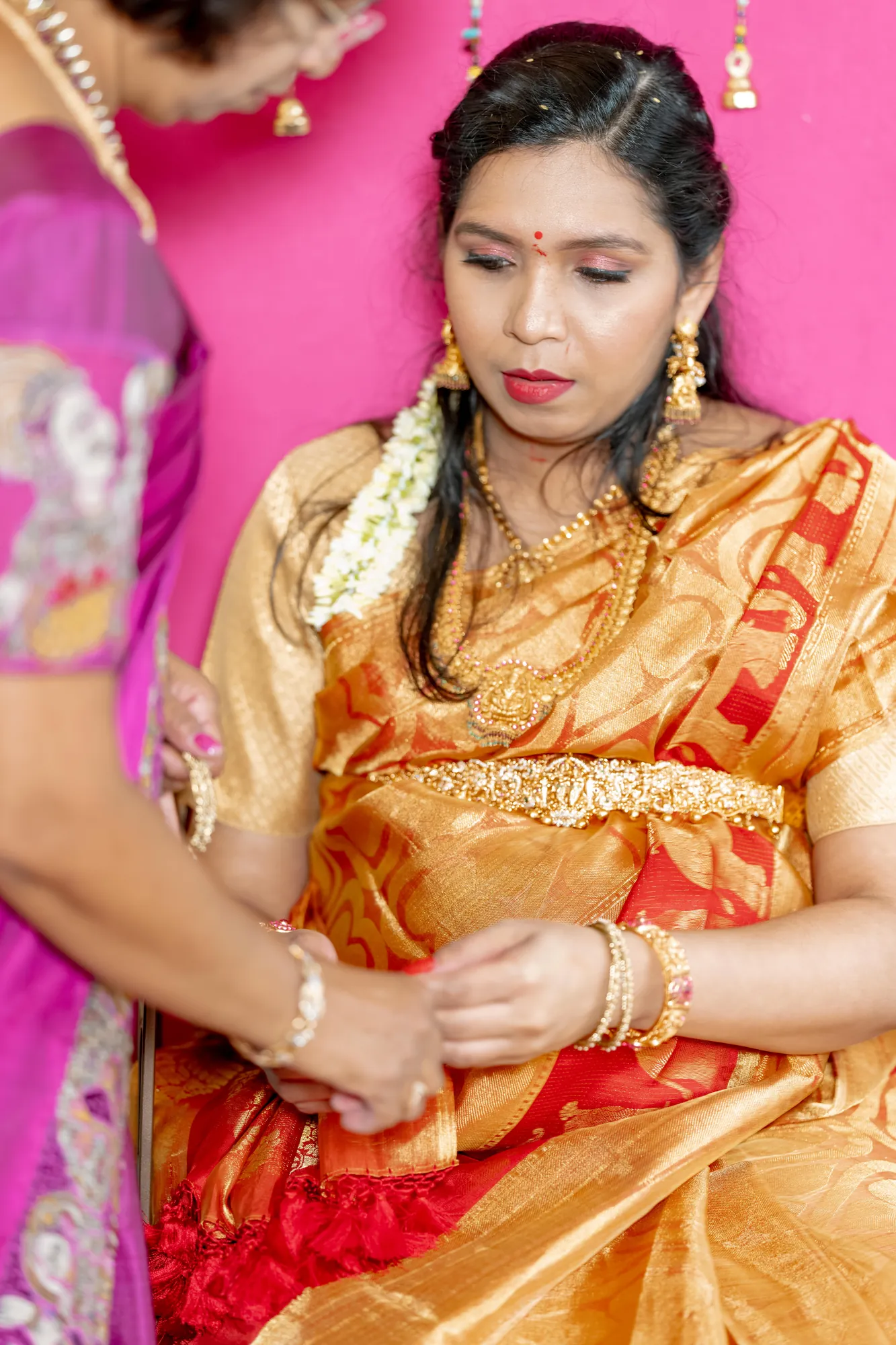
Then photograph them going on, with the hands, the wrist and her face in one frame. The frame worth waiting for is often not her smile at the camera but the moment she looks down at her own wrist as a bangle slides on.
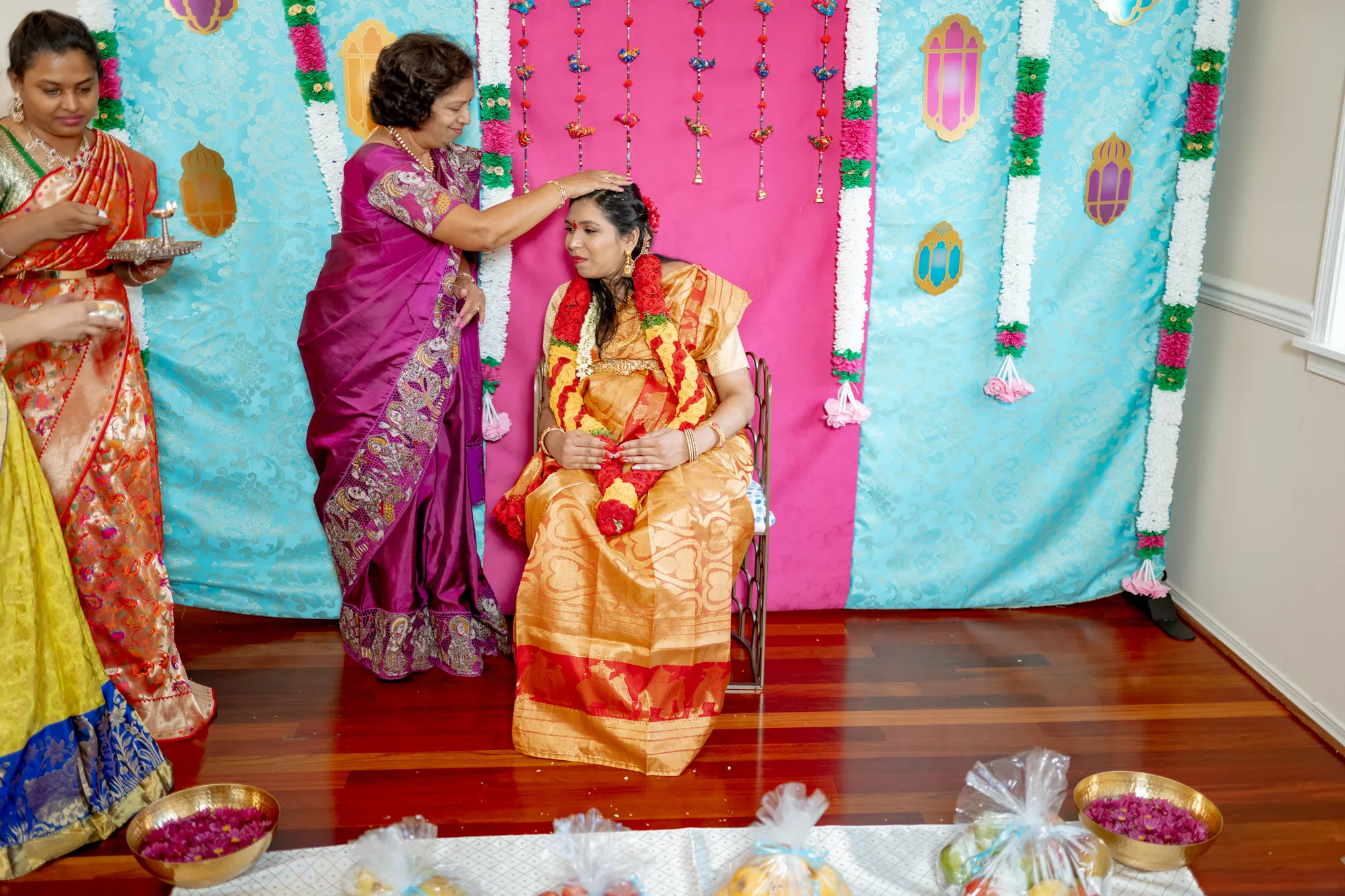
Blessings by the elders. An elder resting a hand on her head, or scattering a few grains of rice over her, is over in a moment. We keep the camera up through each blessing instead of waiting for a pose, because her reaction as the hand comes down is the photo.
Turmeric and kumkum. In many families the blessing includes turmeric and kumkum on her cheeks, forehead or hands. The first touch deserves a close frame; after that we step back so the line keeps moving.
Aarti. The aarti plate and its small lamp circle in front of her, sometimes held by several women at once. We shoot without flash, because the flame is the point of the photo, and take a short burst so one frame shows the flame clear of everyone's faces.
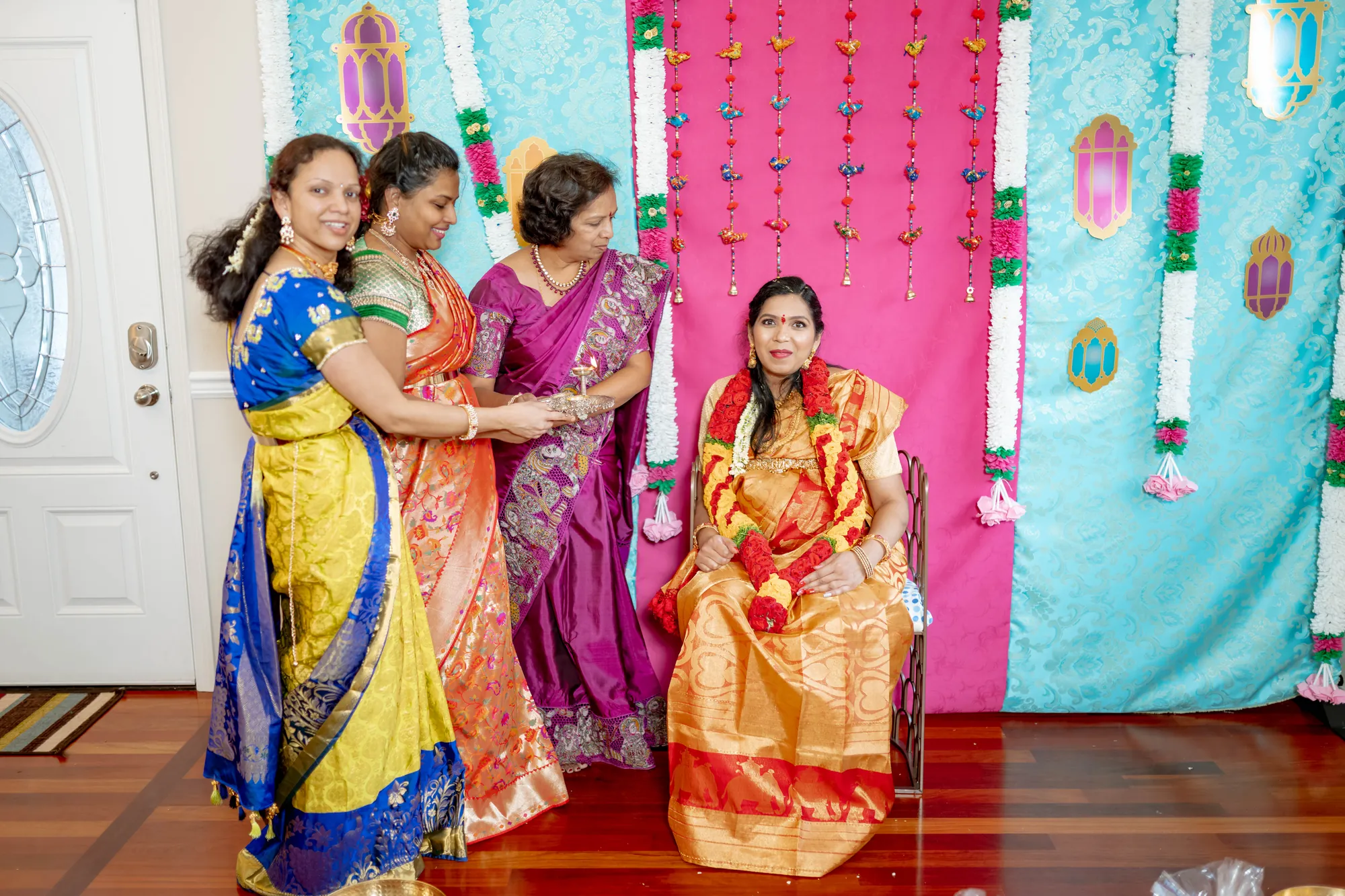
Flowers, sweets and the lap-filling. In many families the women pin jasmine or other flowers into her hair as part of the blessing; get one frame from behind as they go in. Then photograph the first sweet offered to her and, in a Godh Bharai, her full lap.
The couple. Even when the women lead the ritual, ask for a few frames of the two of you at the backdrop while she is still garlanded.
An Indian Baby Shower Shot List You Can Share
Share this shot list with us before the day and cross off anything your family does not do:
- The ritual area, empty, before guests arrive.
- The ritual plates: bangles, flowers, turmeric and kumkum, fruit and sweets.
- Getting ready: saree pleats, jewelry, flowers going into her hair.
- Each elder's blessing, with both faces visible, and the bangles going on.
- The aarti, with the flame showing.
- The lap-filling, or the first bite of her favorite food.
- The couple, and the husband's part in the ritual if there is one.
- Portraits of her alone at the backdrop, and candid laughter between rituals.
Which Family Groups Should You Photograph, Generation by Generation?
Photograph the mother-to-be with each generation that blessed her, because the ceremony itself is one generation blessing the next:
- With her mother and grandmother, or the eldest woman present.
- With her mother-in-law and the elders from her partner's family.
- The couple with both sets of parents, then with the grandparents.
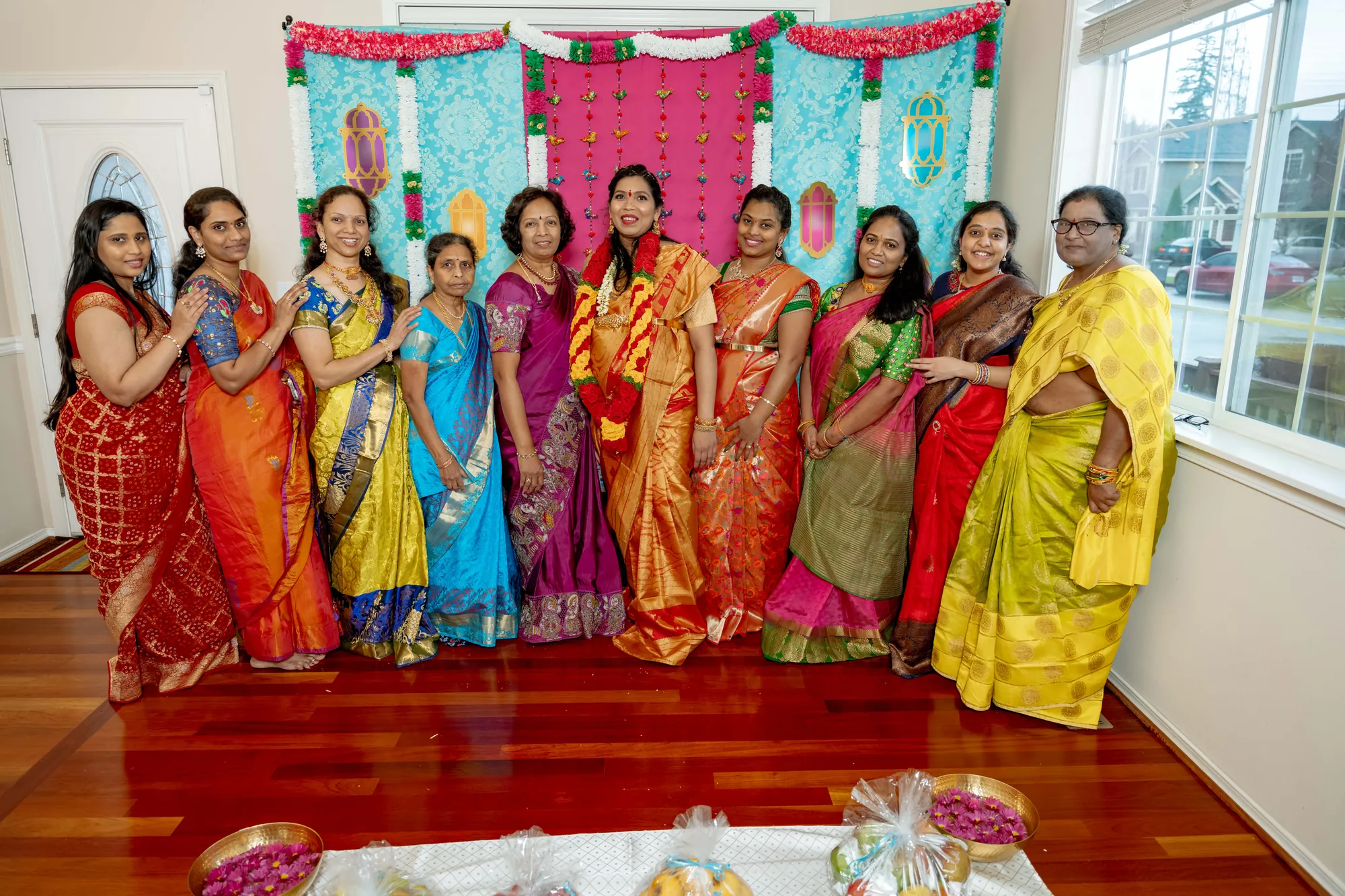
- The women who blessed her, elders seated in front and younger women behind.
- Her sisters and cousins, with the children of the family at her feet.
If you only have time for one group, make it the women who blessed her, with the mother-to-be at the center in her garland. A row like that often runs wider than the backdrop, so clear the wall on either side too.
What Can the Mother-to-Be Wear?
A silk saree is a common choice, and a lehenga or an anarkali suits families where that is the custom. For the photos:
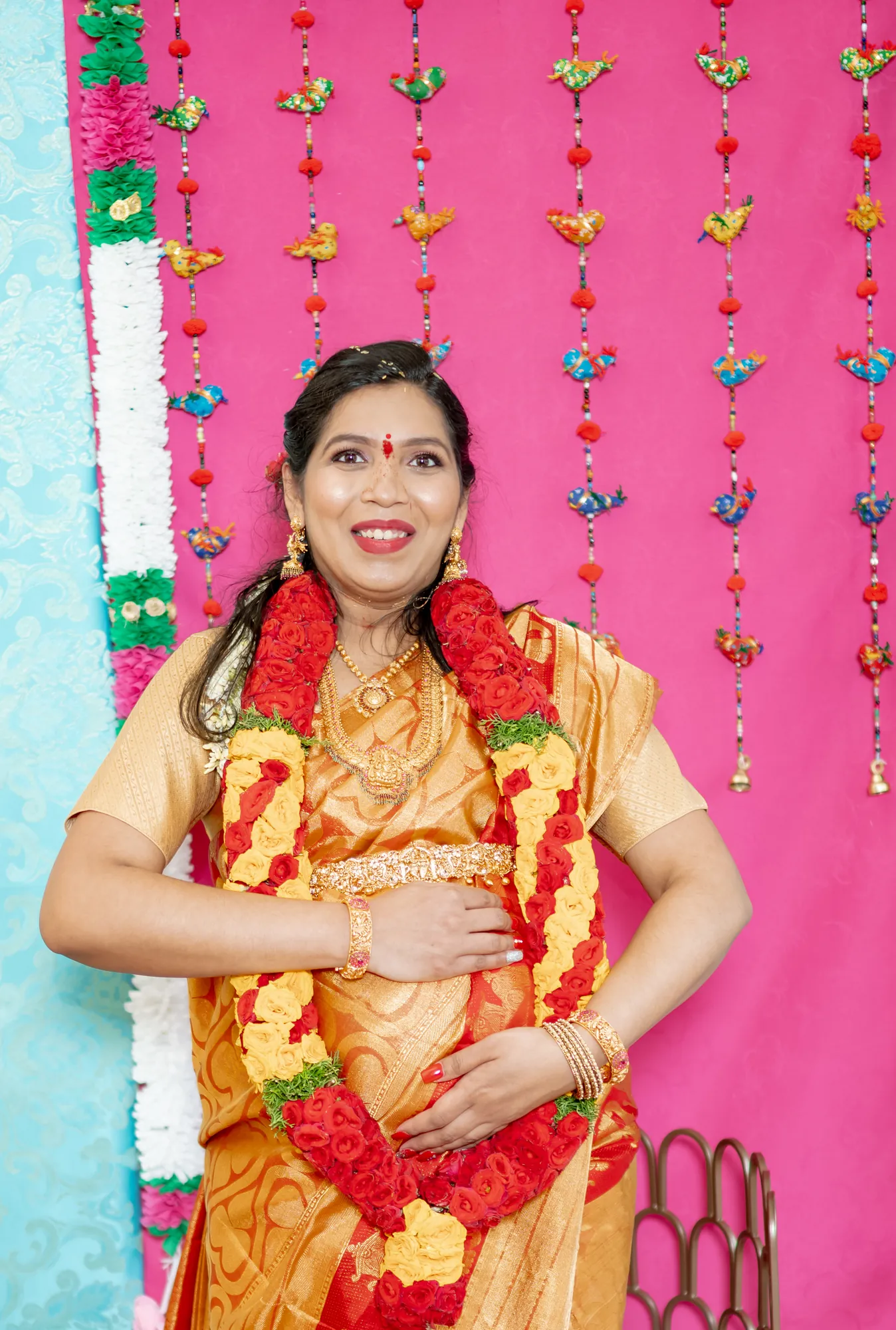
- Contrast with the backdrop. A gold or deep red saree against a pink backdrop, as in the portrait at the top of this page, keeps her from blending into the decor.
- Comfort for a long sit. Pleats that sit flat and a blouse with room to breathe.
- A pallu pinned to show the bump for portraits, and pinned securely whenever the aarti lamp is near.
- Bare wrists to start, so the bangle ceremony has room, with sleeves that keep the wrists in view.
- Hair in a braid or low bun, which holds jasmine strands well.
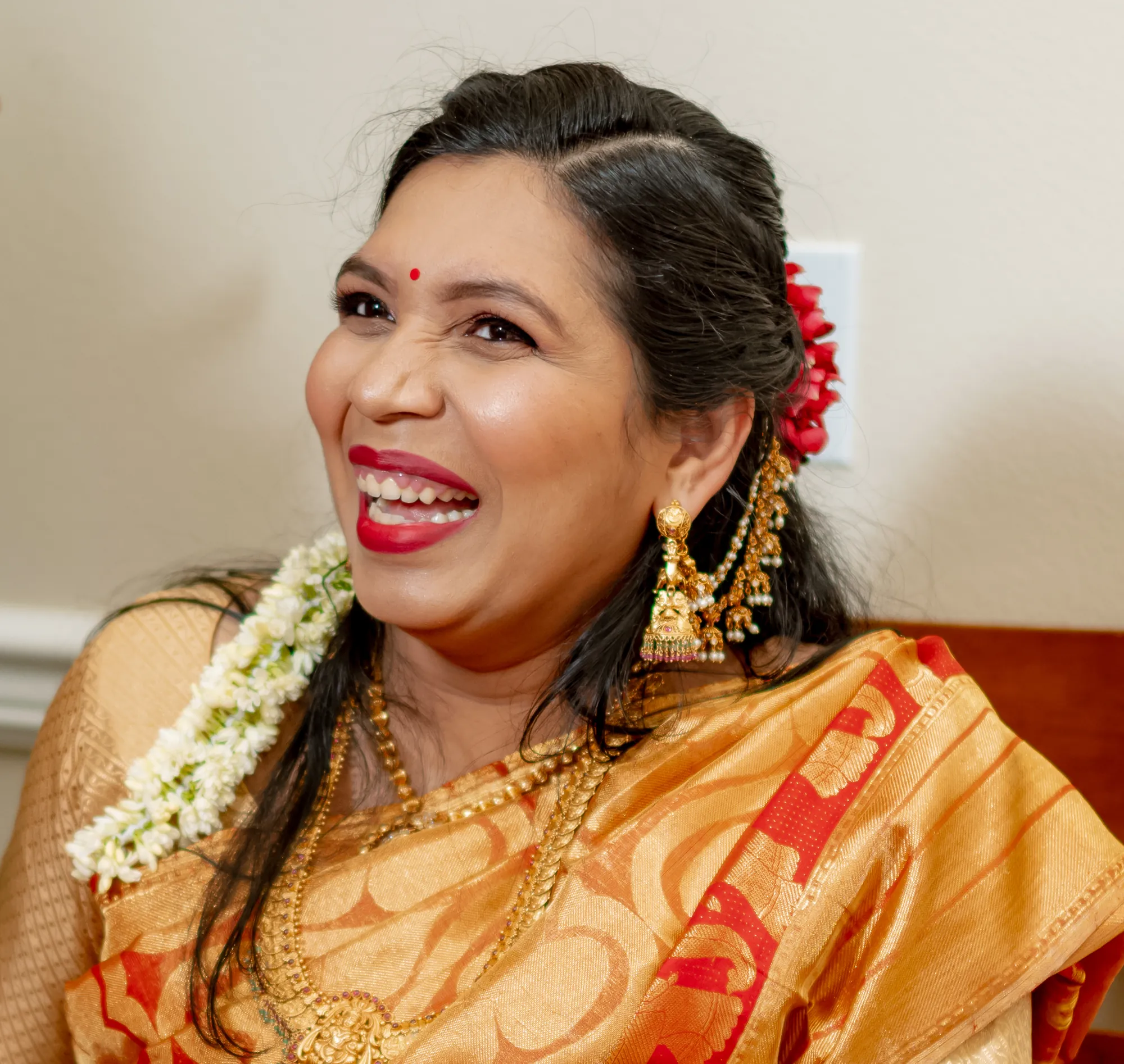
Jasmine over the shoulder, red flowers in the hair and gold jhumkas against a gold silk saree carry a close portrait on their own. Our Diwali what-to-wear guide has more on silk colors in warm indoor light, and for a separate portrait session of the bump, see our maternity photography page.
How Should the Ritual Area Be Set Up So It Reads on Camera?
Set it up as a simple frame around her: a backdrop that contrasts with her outfit, the ritual plates in tidy rows on a cloth in front of the chair, and nothing between her face and the elders who bless her. Window light and floor space are covered in our guide to planning baby shower photos at home; this part is about making the ritual easy to read.
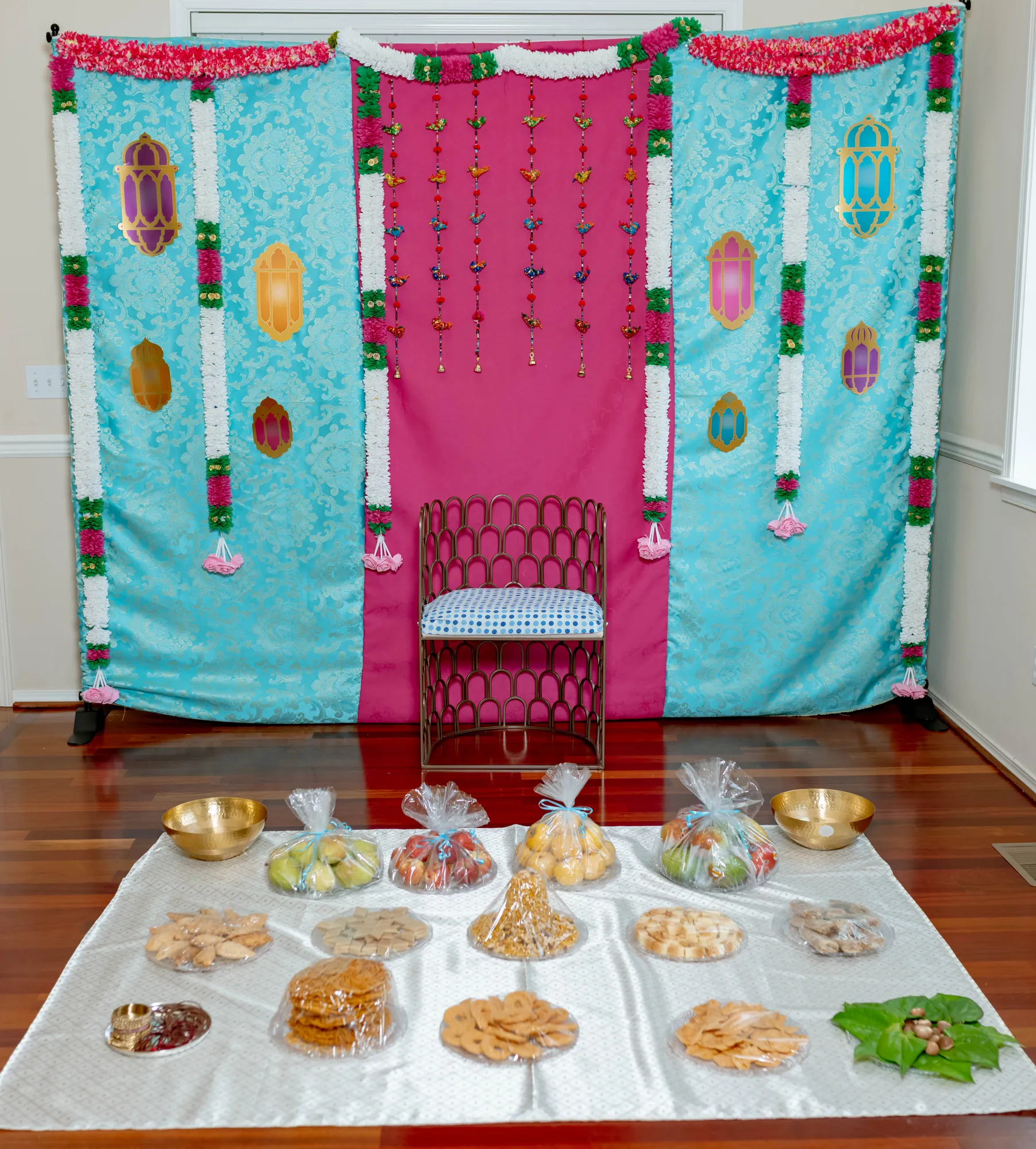
- Photograph it empty first, before the first guest sits down, as in the frame above.
- Lay the plates out in rows on a plain cloth: sweets, savory snacks, fruit, and betel leaves with areca nuts. A white or cream cloth keeps the colors true.
- Hang garlands down the sides so they frame her without hiding the backdrop.
How Is Indian Baby Shower Photography Priced and Booked?
Indian baby shower photography starts at $450. We book it as an Indian family ceremony and price it on the hours of coverage and the size of your family, with travel beyond our usual area quoted separately. As with every ceremony on our Indian family ceremonies page, editing and a private online gallery are included, delivered in 3 weeks. For weekend ceremonies, 4 to 8 weeks of notice is ideal. For a quote, send us the date, your city and what your family calls the ceremony.
Where We Fit
We're Sunny and Tina, a husband-and-wife photo and video team based in Lake Stevens, photographing family ceremonies across Snohomish County and the Eastside, including families in Bothell. We ask before photographing anything sacred. Celebrating Diwali too? See our Diwali family portraits planning guide.
Planning a Seemantham, Valaikappu or Godh Bharai? Reach us through our contact page, check your date, or text (708) 677-7136. We reply within the hour, 7 days a week.