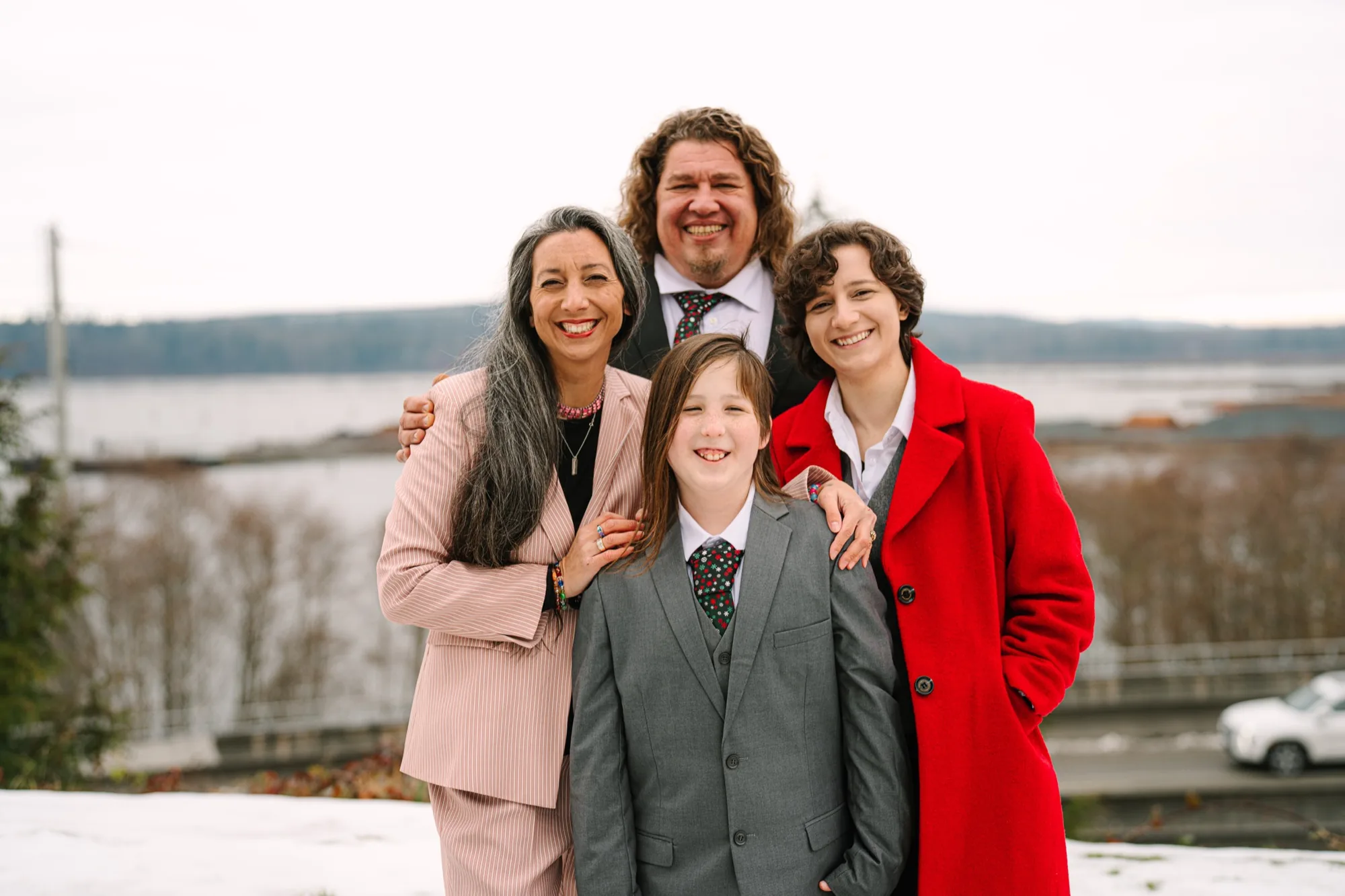
Nearly every family I photograph between October and December asks the same question within about ninety seconds of booking: "So what should we wear?" It is the part people genuinely stress about, and it is also the part where a little planning makes the most visible difference. Holiday and winter sessions are harder to dress for than summer ones. You are layering for cold, working against a grey Pacific Northwest sky, and often shooting against evergreen or bare branches rather than open golden fields.
This is the guide I send my winter clients. It covers the palettes that actually photograph well here, how to coordinate without matching, what layering does for a photo, the fabrics and colours that quietly cause problems, and how to dress kids and grandparents so everyone is comfortable enough to look relaxed. If you are still choosing a date, my holiday card timeline explains why mid-October is the real deadline. For general, non-seasonal advice, my what to wear for family photos guide covers the fundamentals.
Start With the Background, Not the Outfit
The single most useful thing you can do is decide where you are shooting before you decide what to wear. A winter session in Snohomish County usually means one of three backdrops, and each one wants something different.
Evergreen forest or a tree farm gives you a deep, saturated green wall behind you. That background is already doing a lot of work, so your clothes should stay quiet, creams, oatmeal, camel, soft white, grey. Red reads as genuinely festive here rather than loud, because there is so much green to balance it.
Waterfront or open field in winter: think the Lake Stevens shoreline or a bare park, is the opposite problem. The background is pale: grey water, grey sky, bleached grass. Here you want more contrast in your clothing, or everyone disappears into the haze. Navy, deep green, rust, burgundy, charcoal.
Indoor or studio holiday setups are the most forgiving and the place where texture matters most, because there is no landscape to carry the frame. Velvet, knit, corduroy, and wool all photograph beautifully in soft indoor light.
Palettes That Work Here
Pick three to four colours total for the whole group and let everyone pull from that set. Not one colour, three or four. These four palettes work reliably against Pacific Northwest winter light:
Warm neutrals. Cream, camel, oatmeal, soft brown, with one deeper anchor like chocolate or rust. This is the safest and most timeless option, it never looks dated in five years, and it works against literally every winter background we have. If you are unsure, choose this.
Deep jewel tones. Emerald, burgundy, navy, plum. Rich, festive without being costume-y, and genuinely excellent against grey skies and bare branches. Keep them muted rather than bright, a deep forest green photographs far better than a saturated Christmas green.
Classic winter monochrome. Charcoal, grey, cream, black, white. Modern and clean, especially indoors or against snow. Add texture (a chunky knit, a wool coat) so it reads as considered rather than flat.
Muted red accent. If you want the holiday-card look, do it with restraint: one or two people in a muted brick or cranberry red, everyone else in cream and grey. Everyone in bright red reads as a uniform, and it is the most common mistake I see.
Coordinate, Don't Match
Matching outfits (identical shirts, everyone in the same red sweater) flatten a photo. Coordinating outfits let each person stay recognisable while the group still reads as one. The practical method: choose your palette, then have each person pick a different item from it, and vary the texture and pattern weight across the group.
Aim for a mix of solids and one or two small patterns. A subtle plaid, a fair-isle knit, or a soft stripe adds interest; three competing patterns compete. A good rule is one patterned piece per two or three people. Vary the value too, if everyone wears the same mid-tone, the group merges into a single block. Put your lightest and darkest pieces on people who will stand at opposite ends.
Start with one person's outfit (often whoever is hardest to shop for, usually a teenager) and build everyone else around it. Building outward from a real garment is much faster than trying to design the whole group in the abstract.
Layers Are Your Best Friend
Layering solves two problems at once. It keeps everyone warm enough to actually smile, and it gives us visual depth, a cardigan over a knit over a collar reads as far richer than a single flat sweater.
It also gives us variety inside one session. Coat on for the wide shots, coat off for the close ones, scarf on, scarf off. That is three different looks from one outfit without anyone changing clothes in a cold car. Bring the layers even if you are not sure. It is much easier to remove one than to conjure one.
Do bring real coats. A family shivering in thin sweaters for a "better" photo always looks worse than a family who is comfortable, because tension shows in shoulders and faces. Good wool coats photograph beautifully. We can shoot around a puffy jacket by using it in some frames and setting it aside for others.
What to Avoid
A short list, and each one is a real problem rather than a matter of taste.
Large logos and slogans. The eye goes straight to text every time. Avoid character prints on kids for the same reason.
Neon and highly saturated brights. Bright colours bounce their colour onto skin in overcast light, a neon green jacket gives the wearer a green chin. This is the one people never anticipate.
Tight, high-contrast patterns. Narrow stripes and small checks can shimmer strangely at high resolution.
Everyone in pure white or pure black. White loses all detail on a bright overcast day; black becomes a shape with no texture. Cream and charcoal do the same job and keep their detail.
Brand-new shoes nobody has walked in. Winter sessions involve wet grass, gravel, and mud. Comfortable boots people can actually walk in are worth more than shoes that look perfect and hurt.
Kids, Toddlers, and Grandparents
Dress children for the temperature they will experience standing still, not the temperature you feel walking. Kids stop cooperating the moment they are cold, and it happens faster than parents expect. Thermal layers under the nice outfit are invisible and buy you twenty extra good minutes.
Let older kids and teenagers have real input inside the palette. Someone wearing something they hate shows it in every frame, and no amount of direction fixes it. Give them the three colours and let them choose the garment.
For grandparents, prioritise comfort and warmth over everything else, and check footwear against the terrain, if we are on a trail or wet grass, tell me in advance and I will pick a spot with better footing. Bring a folding chair if standing for thirty minutes is difficult; some of my favourite multi-generation photos are built around someone seated.
Finally, pack one full backup outfit for anyone under about six. Not as a plan, as insurance. Hot chocolate happens.
A Simple Week-Before Checklist
Lay every outfit out together on a bed a week before the session, not the night before. Seeing them side by side tells you immediately whether the group reads as coordinated, whether two people have accidentally worn the same thing, and whether anything needs ironing or replacing. There is still time to fix it a week out. There is not time the night before.
Then check the forecast two days ahead, add the layers that need adding, and stop thinking about it. If you are genuinely stuck, text me a photo of the outfits laid out. I would much rather help you choose beforehand than work around it on the day.
Ready to Book Your Winter Session?
Once outfits are settled the rest is easy. Our seasonal mini sessions are $225 for twenty minutes and ten edited photos, delivered within a week, ideal if you mainly need a card image. For extended family, multiple locations, or a set you want to print large, book a full family session. You can see current collections on the pricing page or read more about family photography in Snohomish County. Questions about outfits? Text Sam at (708) 677-7136, genuinely, send the photo.